Showing posts with label Military. Show all posts

Tuesday, December 5, 2023

“Island Fortress”

“The island of Oahu offered the best natural port in the Hawaiian Islands and once the US Navy committed to establishing a major base there, the Army was assigned and enthusiastically undertook the mission to defend this against all known threats” (4).

The Book

When most people hear “Pearl Harbor” their immediate reaction is to think of the Japanese attack on Pearl Harbor in 1941, which caught the US Army and Navy by surprise. What people don’t realize is the amount of thought and work that went into fortifying the island of Oahu from a naval and amphibious landing attack, not an attack from the air. Defenses of Pearl Harbor and Oahu 1907-50 introduces the reader to that fortification process.

Initial defense plans were developed in 1901, taking advantage of Oahu’s natural features and focusing on coastal and land attacks. From 1907 to 1938, the Army spent $150 million on defenses. Batteries (gun emplacements) were built at strategic locations along the coast; eventually there would be fifteen. They were typically two stories of reinforced concrete, with large guns on the upper level and smaller guns on the lower level. In addition, both the Army and Navy built airfields and anti-aircraft defenses. After the surprise attack on December 7, 1941, underground facilities were built and naval turrets were adapted for coastal defense. Post-World War II, many of the defense sites were adapted for different uses by the Army and Navy. Most still exist today because they were built to withstand an attack and are too difficult to destroy.

Authors McGovern and Williford do a good job of describing the design and construction of the various defense mechanisms around Oahu. For the most part, the information is easy to follow and doesn’t get too technical. However, this book is definitely more for a niche audience: those interested in military history and defense. The photos and illustrations throughout the book have very clear and detailed captions. There are a handful of computer illustrations that provide a detailed look when a photo isn’t available or descriptive enough. I appreciated these, but sometimes found the captions hard to read (they were often black text on a dark background).

The Place

The US Army Museum of Hawaii is located in Battery Randolph, one of the batteries built to help defend Oahu. Visitors learn about a variety of topics related to the defense of the Hawaiian Islands. I really enjoyed the museum because of this variety. The building itself is unique, made out of reinforced concrete with no windows. Interspersed throughout exhibits are mannequins staged to operate the battery against attackers. Exhibits about Hawaiian warriors defending their island precedes exhibits on the work of the US Army to build up the island’s defense. The impact of World War II on the military, civilian population, and Japanese Americans is explored. Finally, visitors learn about the role Hawaii played during the Vietnam War.

If this is the type of museum you enjoy, I would recommend planning plenty of time. We stopped in, after another tour, and ended up rushing through the last parts. While it doesn’t appear to be a big museum, there is a lot of information packed in. The museum is open Tuesday-Saturday from 10am-5pm and admission is free. It is a part of Fort DeRussy and located in the heart of Waikiki. In fact, the famous beach is just on the other side of the battery.

Tuesday, October 28, 2014

A Nation Remembers

“By the dawn of the twentieth century, Arlington had matured into something more than a Civil War cemetery; it had become a national symbol for sacrifice and honor, a rallying point for veterans, for ordinary visitors, and for solemn ceremony” (119).

The Book

On Hallowed Ground: The Story of Arlington National Cemetery by Robert M. Poole provides the reader with a history of America’s most famous cemetery. Arlington National Cemetery was born out of the Civil War and has been inexplicable linked to each of America’s wars since then. The land originally belonged to Mary Custis Lee, the wife of Robert E. Lee and great-granddaughter of Martha Washington. When Robert E. Lee chose to resign from the Union and lead the Confederate army, Arlington became a part of the Union’s defense of Washington, DC. Throughout much of its early history, the cemetery was a bridge, and was caught, between the struggle between the North and the South.

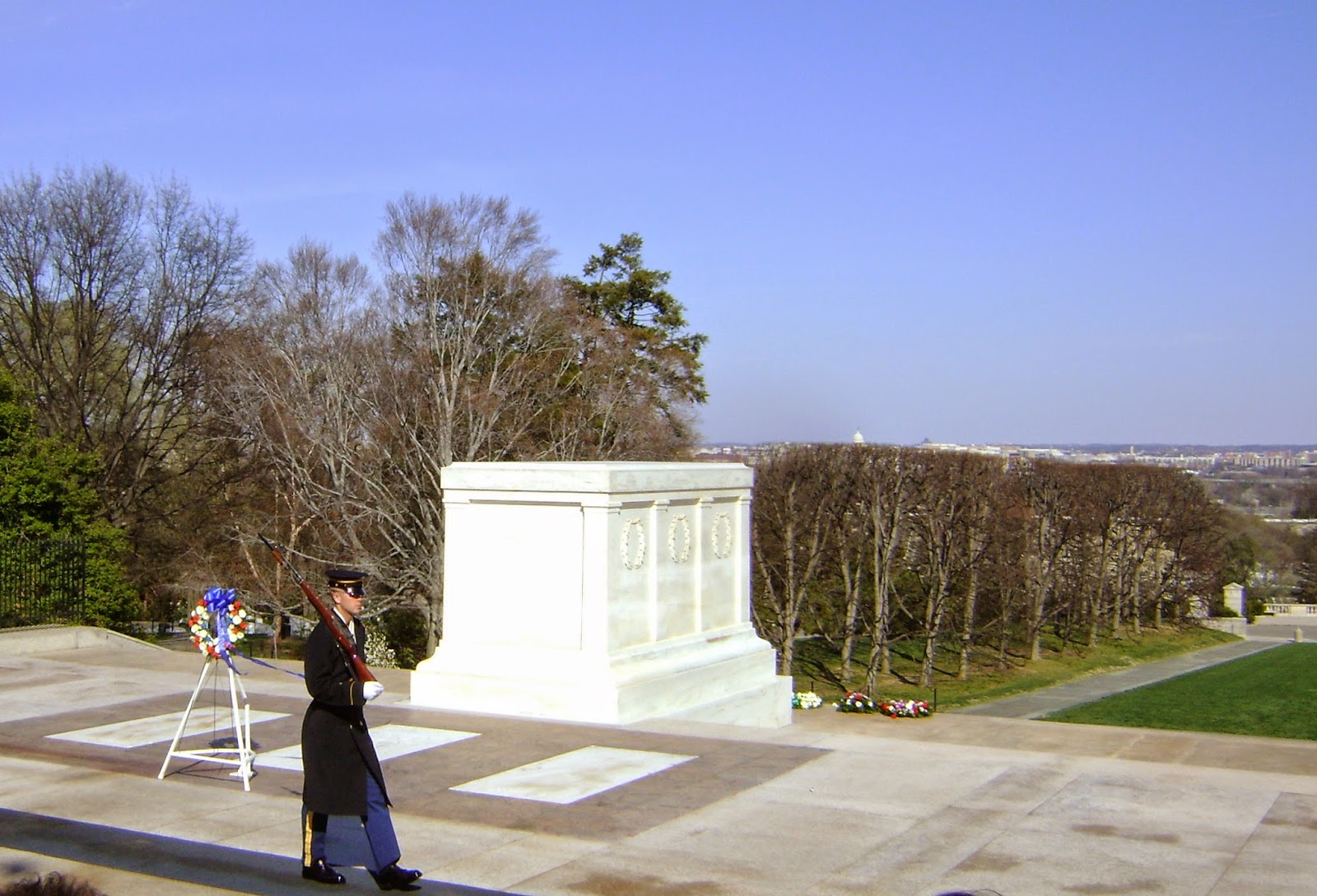
Arlington began as a 200 acre cemetery in 1864 and has grown to 624 acres. The white tombstones were put into practice in 1874 and the Tomb of the Unknown was dedicated on November 11, 1921. The United States Army Old Guard is tasked with the twenty-four hour guarding of the Tomb of the Unknown. The best part of On Hallowed Ground is Poole’s description of the Old Guard and their reverence for the Unknown Soldiers.

Overall, Poole does a good job explaining the creation of the cemetery and the people involved. However, some aspects of Arlington’s history and traditions are glossed over in deference to other events. For example, Poole spends an entire chapter on President Kennedy’s funeral, while only a couple of pages detailing the Old Guard. This decision plays into the complaints Poole details from the families who lost ordinary soldiers: more important people were often given more prominent burial plots and better funerals than the ordinary soldier.

The Place


Arlington NationalCemetery is located across the Potomac River from the Lincoln Memorial. Tours are available and they stop at the Tomb of the Unknown, President Kennedy gravesite, and Arlington House. Visitors can pick up a map at the Visitor Center to find the gravesites of famous Americans or family members.

The Tomb of the Unknown is humbling and the viewing of the changing of the guard is a unique experience. As you stand in the crowd, all you hear is the clicking of the soldier’s heels and you are struck by the sacrifice of the Unknowns and their families. Across from the Tomb of the Unknown are several memorials for the USS Maine, the Iran Hostage Rescue Team, and the Space Shuttles Challenger and Columbia. At the Arlington House, you have a sweeping view of the Potomac River and Washington, DC. Just in front of Arlington House lies Pierre Charles L’Enfant. L’Enfant was a Frenchmen who served in the Revolutionary War and designed the layout for the new capital city: Washington, DC. For his devotion to his adopted country, L’Enfant’s grave has the best view.

A visit to Arlington is not your typical tourist stop; it is a cemetery and visitors are expected to be reverent and respectful.