“The watcher was beholding something never before seen from this spot,
and never seen again-two great armies, bound for the greatest and most violent
collision the North American continent had ever seen” (5).
The Book
 Gettysburg: The Last Invasion by Allen C. Guelzo is a complete recounting of the Battle of Gettysburg,
from Robert E. Lee’s plan to attack on Northern soil to the dedication of the Gettysburg Cemetery.
Gettysburg: The Last Invasion by Allen C. Guelzo is a complete recounting of the Battle of Gettysburg,
from Robert E. Lee’s plan to attack on Northern soil to the dedication of the Gettysburg Cemetery.
Guelzo
divides the book into four parts: The March Up, The First Day, The Second Day,
and The Third Day. Each section provides a description of the people, places,
and events that make the narrative come alive. The division helps the reader
understand what happened throughout the several days of battle. Equal time is
given to the lead up to the battle, and three consecutive days of smaller
battles. The Third Day section describes the Confederate attack so well that
the reader can easily picture the lines of advancing soldiers.
Gettysburg provides a lot of
detail that can be difficult to process. It can be hard remembering which side
a person was a part of and where he fits into the battle. The numerous maps in
the book help the reader visualize troop movements and places of battle. Any
history buff will find this book fascinating, but it might have too much depth
for the average reader.
The Place
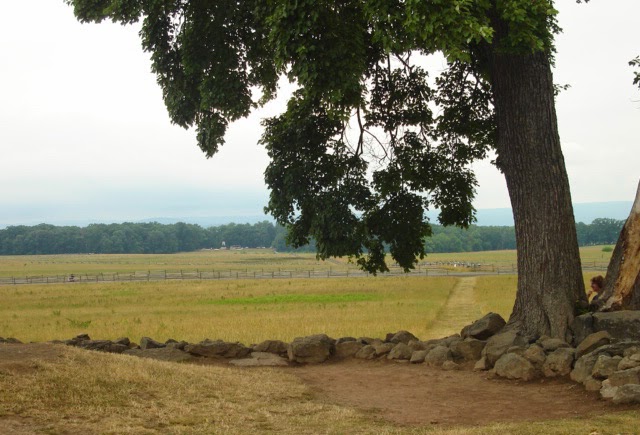 Gettysburg National Military Park is a moving
place to visit. It is wise to plan at least two days to tour the park and museum.
Entry to the park is free, but the Museum and Guided Tours have a fee.
Gettysburg National Military Park is a moving
place to visit. It is wise to plan at least two days to tour the park and museum.
Entry to the park is free, but the Museum and Guided Tours have a fee.
There are
several options for touring the battlefield: licensed battlefield guide, guided
bus tour, or a self-guided auto tour. My family and I used the self-guided auto
tour and enjoyed our freedom to take our time at each stop. The Visitor Center provides visitors an introduction
to the battle and an opportunity to view the Gettysburg Cyclorama.
You don’t fully
comprehend the magnitude of the Battle of Gettysburg until you visit the site. As you stand atop Little Round Top and look down on Devil’s Den, you appreciate the sacrifice of the men who prevented the Confederates from flanking the Union lines. I remember standing on the Union embankments and looking across the field to
the Confederate lines. The Union soldiers fought hard to repulse the Confederate attack and begin the end of the Civil War.

