Showing posts with label Washington DC. Show all posts

Tuesday, May 25, 2021

Bearing Witness

Author’s Note: There are no photos to accompany this blog post. While photographs, without flash, are permitted at the United States Holocaust Memorial and Museum; I chose not to take photos when I visited.

“The location of the museum asked visitors to ‘pay attention’ to a crucial memory, and the attributes of the building informed visitors that they must, in order to pay attention, leave Washington” (89).

The Book

Any book that tells a piece of the Holocaust narrative is a weighty book to read. You come face to face with how depraved humanity can be and the senseless murder of millions of people, simply because of their ethnicity. Preserving Memory: The Struggle to Create America’s Holocaust Museum by Edward T. Linenthal is no different. However, the overall purpose of the book is different: a chronicle of the 15-year struggle to determine how best to remember the Holocaust in the United States. 

Linenthal begins the book with the 1993 dedication of the United States Holocaust Memorial and Museum and traces how the Holocaust was ignored, forgotten, or downplayed until the 1960s. Numerous events, both in America and abroad, resulted in President Carter creating the President’s Commission on the Holocaust in 1978. From this point, Linenthal launches into an in-depth narrative: the early days of the commission and struggle with how to memorialize, the location and building, the permanent exhibit, and the role of the museum in memory. 

Section one details the beginnings of an idea to remember and commemorate, something that the average person isn’t often privy too. The commission, originally chaired by Elie Wiesel, faced the challenges of how to remember the Holocaust and who to remember (only Jews or other victims of the Nazis). Wiesel, and many other commission members, argued for the focus to be on Jews only and to educate, not only memorialize. Section two walks readers through how the location and architect were chosen. Linenthal helps the reader visualize the museum, pointing out the meaning behind the architectural designs, both inside and outside. Sections three and four break down the thoughtful decisions that went into the design of the permanent exhibit. Staff members struggled over what to include and where to place items in the museum’s narrative. Finally, section five looks at how the memory on display at the United States Holocaust Memorial and Museum impacts us today.

As I read Preserving Memory, my mind was transported back ten years and I vividly remembered walking through the museum, in ways I hadn’t for years. Linenthal places the reader in the museum with his descriptions of architecture, exhibit space, and artifacts. He also allows the reader a glimpse into the decision-making process and the meaning behind seemingly simple decisions (i.e., only glass, steel, and stone were used in construction to indicate permanence, and photos of Jews before the Holocaust enabled them to be remembered as they were, not how Nazis viewed them). The controversies are not glossed over, but given due space. These include the location of the museum, the exclusion of other victims of the Nazis, the use of certain artifacts, and the actual role of the museum. The overall book is grounded in first hand narratives from commission members and other key players in the development of the museum. Their thoughts, arguments, and counterarguments show their struggles with how to best remember an event many of them survived.

The Place

The United States Holocaust Memorial and Museum is located adjacent to the National Mall and Washington Monument in Washington, DC. While it points visitors to a very different historical event than the rest of the iconic spots on the National Mall, it is still just as important. The permanent exhibit begins with an elevator ride, a confined space, that transports visitors to the fourth floor. They join with American soldiers as they encounter the concentration camps and then go back in time to the rise of Nazi power. Artifacts, images, videos, text, and models serve as witnesses to the attempt to destroy an entire group of people. The weight of the exhibit grows heavy as visitors make their way back down to the first floor, ending with videos of survivors sharing testimonies. Finally, the Hall of Remembrance provides an opportunity to reflect and process. 

The museum just reopened after being closed to prevent the spread of COVID. A free timed ticket is required and all visitors two years old and up must wear a face mask. Two exhibits are still closed to the public, as are the library and resource center. The permanent exhibit is recommended for visitors 11 years and up and can take anywhere from one to three hours. There is no parking facility and visitors are strongly encouraged to arrive via the Metro.

Tuesday, January 31, 2017

The First President

“Fearing anarchy, disunion, and an end to American freedom if he failed to act decisively, [Washington] transformed himself-and the presidency-from a relatively impotent figurehead into America’s most powerful leader…” (3).

The Book
It is common knowledge that George Washington served as the first president of the United States and set many precedents that his successors followed. However, many do not know the reasoning behind the precedents or the extent to which Washington’s fingerprints are on the presidency. In “Mr. President”: George Washington and the Making of the Nation’s Highest Office, author Harlow Giles Unger outlines “the seven pillars of power [which Washington raised] that sustain the mighty American presidency edifice today-the power to control executive appointments, foreign policy, military affairs, government finances, and federal law enforcement, along with the power to legislate by presidential proclamation and to issue secret fiats under the cloak of executive privilege” (3).  

Unger begins his biography at the end of the Revolutionary War and follows Washington through the government of the Articles of Confederation, his leadership of the Constitutional Convention, his eight years as president, and his retirement. During this time period, the reader comes to release the precarious position the United States of America was in: civil unrest over the size of the federal government and taxes, state’s rights, and foreign influence. The reasoning behind Washington’s pillars of power is presented in detail.

There is a lot we can learn from Unger’s well-written biography of Washington. The reader will come away with a better appreciation for the role Washington played in the early stages of our country. Washington struggled with decisions, cabinet infighting, and negative press. He recognized his major failure as president: the inability to unite Americans into one country. The early stages of the United States were not easy or perfect, but Unger credits Washington with laying the groundwork for a stable presidential structure-one that still continues to this day.

The Place
The Washington Monument  was built to honor the man who was “first in war, first in peace, and first in the hearts of his countryman” (Henry “Light Horse Harry” Lee). However, the building of the monument was not simple. A monument was proposed prior to George Washington becoming president, but wasn’t completed until 1884. If you look closely, you can see two different colors because construction was halted for a time.

Inside the Monument, visitors will find a statue of Washington and an elevator ride to the top. The Monument towers over the National Mall and each of the four sides provide breathtaking views of Washington, DC, Virginia, and Maryland.

Currently, the Monument is closed (until Spring 2019) due to work being done on the elevator. Despite the fact that visitors cannot go up in the Monument, it is still a breathtaking site to walk along the National Mall and take it in. If you are planning a visit to Washington, DC in the future, check back with the National Park Service for additional information regarding the reopening. 

Tuesday, July 26, 2016

Author and Protector of Independence

“[…] directly down the lawn and across the Ellipse from the White House are those ordered, classic lines of the Jefferson Memorial and the eyes of the 19 foot statue that gaze directly into the White House…” (503).

The Book

Author Jon Meacham takes the larger-than-life Thomas Jefferson and places him in a biography that captures Jefferson’s life, thoughts, and interactions. Thomas Jefferson: The Art of Power is split into sections that represent the “acts” of Jefferson’s life: early life, American Revolution, Governor, Congressional Representative, Diplomat, Secretary of War, Vice President, President, and last days. Most of Jefferson’s political life hinged on his defining vision, “the survival and success of popular government in America” (xx).

Thomas Jefferson is a familiar figure to Americans. What sets this biography apart is the inclusion of Jefferson’s own words. The reader is able to read what Jefferson thought about the Declaration of Independence or the difficulties of being the president. Each chapter weaves Jefferson’s words and the words of his relatives with the author’s words. By relying on Jefferson’s words, Meacham provides the means for the reader to visualize and understand Jefferson.

Thomas Jefferson: The Art of Power does not shy away from the controversies in Jefferson’s life or the clashes he had with other significant Americans. Jefferson was a strong personality who held strong beliefs, which he sometimes contradicted in practice. The biography is well-researched and well-written. Readers familiar with Jefferson will be introduced to new stories and the words of Jefferson. Readers unfamiliar with Jefferson will find this biography easy to read and come to realize the significance of America’s third president.

The Place

The Jefferson Memorial in located on the National Mall in Washington, DC. As a part of the National Park Service, the Memorial is free and always open for visitors. Inside the Memorial is a 19 foot statue of Thomas Jefferson and inscribed, on the walls, are various quotes by Jefferson.

It is impressive for any visitor to walk into the Rotunda and gaze up at one of the Founding Fathers. The quotes on liberty and government remind the visitor of Jefferson’s insight. Outside the Rotunda, visitors to can walk down the steps to the edge of the Tidal Basin. The Jefferson Memorial also offers one of the best views of the Cherry Blossom trees. They are usually in bloom in March and April.

Tuesday, April 19, 2016

Out of Many Ideas, One National Mall

“Much of the Mall’s visual strength lies in its scale. From the Capitol to Fourteenth Street, the broad, linear space creates a sense of expansiveness commensurate with the bold visions that shaped it, a space that may be said to be emblematic of the vast reaches of the country itself” (14).

The Book

The Mall in Washington, 1791-1991 is a collection of articles that explore the history of the National Mall. The authors write of Pierre L’Enfant’s original plan for America’s new capitol city, various figures who impacted the developments, the landscape, and specific additions to the National Mall.

The National Mall we know now took a long time to develop. In March 1797, 227 acres were set aside for the “health and ornament of the city” (46). Buildings were developed slowly and in 1854, a railroad ran across the National Mall. By the end of the 1800s, it was fragmented into seven separate parks and gardens. The McMillian Plan (1901-1902) attempted to unify the National Mall and work towards what L’Enfant originally envisioned. In 1926, the National Capitol Park and Planning Commission was created to help unify the work on the National Mall. According to Charles Moore, “In the monuments of the National Capitol you shall read the history of America” (144). The buildings, sculptures, landscape, and space attempt to convey meanings to the visitor.

The Mall in Washington, 1791-1991 contains detailed research that delves into the history of a familiar space. It’s not just the history of the National Mall; it also includes the history of Washington, DC and American government, society, and design. At times the average reader might feel bogged down by the academic research, but overall this book is very accessible. The articles are supplemented with hundreds of original drawing plans, photos of scale models, and photos at the various stages of development. These articles help the reader appreciate the careful thought and detailed work that went into the design of the National Mall, landscape, and buildings.

The Place

It is impossible to see everything on the National Mall in one day; there are simply too many museums and memorials. If it is a nice day, a picnic lunch is a great option on the vast open land at any point on the National Mall. If the weather is not great, consider exploring one of the many Smithsonian Museums; they literally have something for everyone. The World War I, World War II, Korean, and Vietnam War Memorials are poignant reminders of the sacrifices of many. My recommendation would be to plan several days to explore the National Mall.

Simply standing at any point on the National Mall can leave you with a sense of awe. Despite the number and size of the buildings, people still seem to dominate the space. When I lived in Washington, DC one of my favorite things to do was to walk the Mall. There is no other place in America like this vast park memorializing great leaders and our nation’s history. 

Tuesday, October 28, 2014

A Nation Remembers

“By the dawn of the twentieth century, Arlington had matured into something more than a Civil War cemetery; it had become a national symbol for sacrifice and honor, a rallying point for veterans, for ordinary visitors, and for solemn ceremony” (119).

The Book

On Hallowed Ground: The Story of Arlington National Cemetery by Robert M. Poole provides the reader with a history of America’s most famous cemetery. Arlington National Cemetery was born out of the Civil War and has been inexplicable linked to each of America’s wars since then. The land originally belonged to Mary Custis Lee, the wife of Robert E. Lee and great-granddaughter of Martha Washington. When Robert E. Lee chose to resign from the Union and lead the Confederate army, Arlington became a part of the Union’s defense of Washington, DC. Throughout much of its early history, the cemetery was a bridge, and was caught, between the struggle between the North and the South.

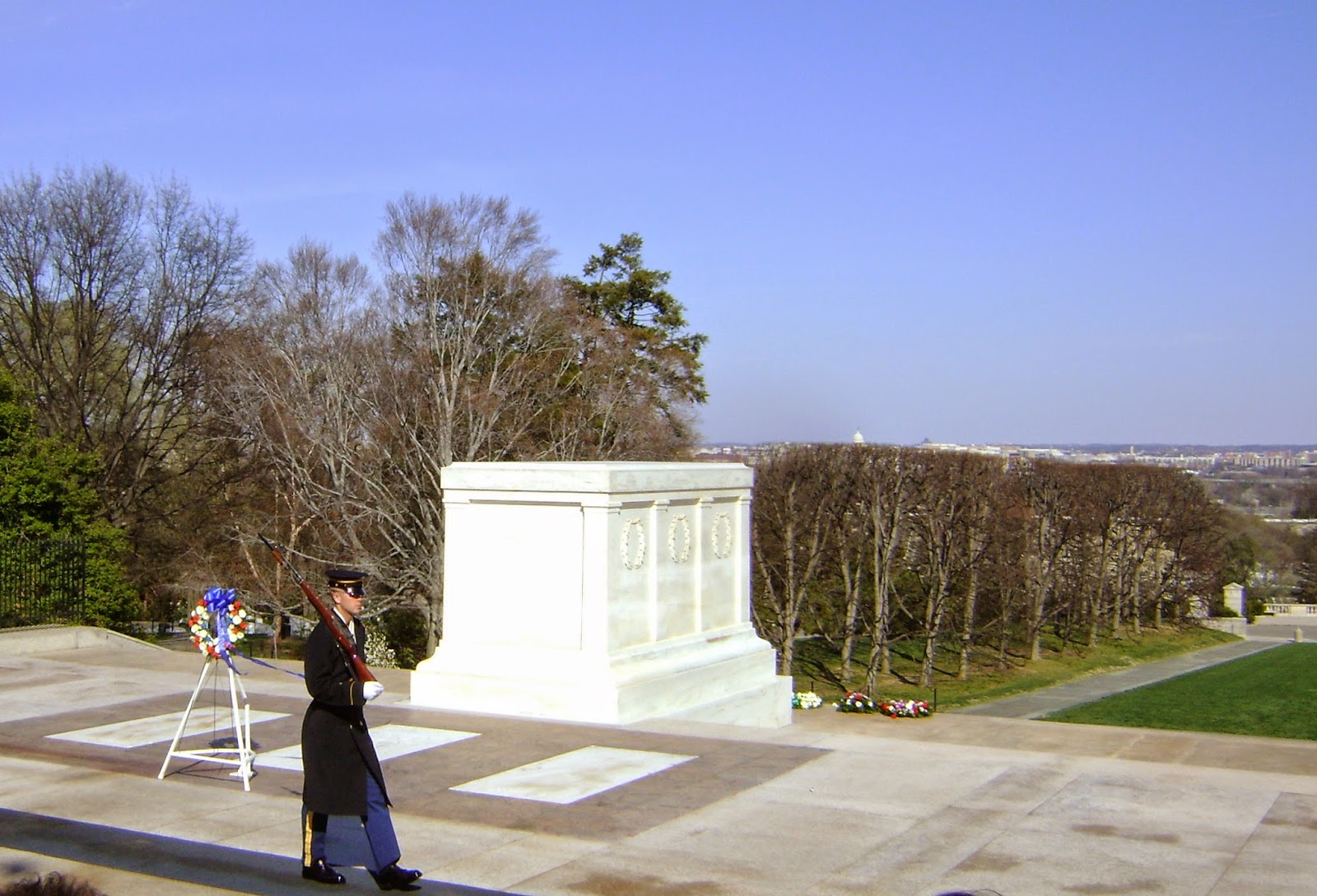
Arlington began as a 200 acre cemetery in 1864 and has grown to 624 acres. The white tombstones were put into practice in 1874 and the Tomb of the Unknown was dedicated on November 11, 1921. The United States Army Old Guard is tasked with the twenty-four hour guarding of the Tomb of the Unknown. The best part of On Hallowed Ground is Poole’s description of the Old Guard and their reverence for the Unknown Soldiers.

Overall, Poole does a good job explaining the creation of the cemetery and the people involved. However, some aspects of Arlington’s history and traditions are glossed over in deference to other events. For example, Poole spends an entire chapter on President Kennedy’s funeral, while only a couple of pages detailing the Old Guard. This decision plays into the complaints Poole details from the families who lost ordinary soldiers: more important people were often given more prominent burial plots and better funerals than the ordinary soldier.

The Place


Arlington NationalCemetery is located across the Potomac River from the Lincoln Memorial. Tours are available and they stop at the Tomb of the Unknown, President Kennedy gravesite, and Arlington House. Visitors can pick up a map at the Visitor Center to find the gravesites of famous Americans or family members.

The Tomb of the Unknown is humbling and the viewing of the changing of the guard is a unique experience. As you stand in the crowd, all you hear is the clicking of the soldier’s heels and you are struck by the sacrifice of the Unknowns and their families. Across from the Tomb of the Unknown are several memorials for the USS Maine, the Iran Hostage Rescue Team, and the Space Shuttles Challenger and Columbia. At the Arlington House, you have a sweeping view of the Potomac River and Washington, DC. Just in front of Arlington House lies Pierre Charles L’Enfant. L’Enfant was a Frenchmen who served in the Revolutionary War and designed the layout for the new capital city: Washington, DC. For his devotion to his adopted country, L’Enfant’s grave has the best view.

A visit to Arlington is not your typical tourist stop; it is a cemetery and visitors are expected to be reverent and respectful.

Tuesday, May 20, 2014

The World's Largest Office Building

“In the Pentagon, the War Department now had a headquarters that was four times the size of the British War Office at Whitehall, the German Kriegsministerium in Berlin, and the Japanese General Staff headquarters building in Tokyo-combined” (296).

The Book


The Pentagon: A History by Steve Vogel provides an in-depth history of the five-sided building that has become an American icon. I recommend all the books I write about in my blog, but this one is one of the best I have read. Vogel takes the reader through each step of the process and introduces a colorful cast of characters.

Prior to 1941, the War Department was scattered in numerous buildings throughout the Washington, DC area. In peacetime, this was a minor issue. As the war clouds loomed in Europe and Asia, this was becoming a crisis. Brigadier General Brehon Somervell was picked to lead the construction of a new, temporary, War Department building. The pentagon shape was conceived over a weekend to follow the height restriction and space requirements. Somervell promised the first workers would move in one year after construction began. The groundbreaking was September 11, 1941 and the first workers moved into their offices on May 1, 1942. 

The final chapters of the book focus on the terrorist attack on September 11, 2001 and the reconstruction of the damaged Pentagon. For anyone who watched the terrorist attacks on television or in person, these chapters bring back many emotions. Instantly you remember where you were and the thoughts you had. The construction crews were committed to rebuild the Pentagon quickly and the first workers moved back in on August 15, 2002. I think Vogel’s final paragraph sums it all up well, “The Pentagon had been conceived over a long weekend. Its design had been one step ahead-and sometimes one step behind-its construction. The pentagonal shape, like so many aspects of the building, was essentially an accident, born of the speed in which the project was pursued. The construction had been slapdash; columns were missing, concrete pours uneven, drawings wrong or missing altogether. Yet somehow the Pentagon was designed wisely and constructed well. Somervell’s building had proven itself one for the ages” (500). 


The Place

The Pentagon is a fascinating place to visit. Tours are provided and you must make reservations in advance. A member of the Armed Forces guides you throughout the halls of the Pentagon explaining each area. There are restrictions when visiting-no photography allowed in the Pentagon and cell phones must be turned off. However, the tour gives visitors a look at the inside of the War Department and the chance to walk where many American heroes have walked.

Included in the tour is the Memorial Chapel for those who died in the September 11th attacks. This is a solemn location that reminds visitors of the ultimate sacrifice so many people made that day. Outside of the Pentagon is the National 9/11 Pentagon Memorial. Each bench represents one of the people who perished and the benches are placed in age order, from the youngest to the oldest. Both Memorials are moving and give visitors a chance to reflect on the events of September 11, 2001.

Tuesday, November 26, 2013

Designing the Capitol


“The city itself would be the American Paris, but better than Paris-a Paris reborn as a republican Rome, a seat of wisdom and power on display for the rest of the world” (14).


The Book


In Grand Avenues: The Story of the French Visionary Who Designed Washington, DC, author Scott W. Berg introduces the reader to Pierre (later changed to Peter) Charles L’Enfant. L’Enfant was born outside Paris and educated at the Royal Academy of Painting and Sculpture before sailing to America to fight in the American Revolution. After the Revolution, America became L’Enfant’s adopted country. He redesigned the temporary seat of government-Federal Hall in New York, before taking on the task of a permanent seat of government.

Berg walks the reader through the decision process regarding a permanent location for the young nation’s capitol. In July of 1790 one hundred square miles on the Potomac River were set aside. L’Enfant surveyed the land while he began to design the layout of the city. His plan was basically “a grid overlaid with a system of public squares linked by radiating diagonal avenues” (102). Berg unpacks the thought and effort L’Enfant put into his plan for Washington, DC. For example, in Versailles, the center was the king’s bedroom. In Washington, the center was the Capitol Building.

The design and building process was not easy. L’Enfant could be a difficult person to work with and often found himself at odds with the commissioners, surveyors, and even Thomas Jefferson. He resigned from the project in 1792. Berg transports the reader to the year 1900 when L’Enfant’s design was finally realized by a team of American architects. This focus on the city plan, as a whole, came after 100 years of focus on the White House and Capitol Building. 


The Place


The Capitol Building was the center of L’Enfant’s plan for the new democracy. The diagonal streets would shoot out like wheels on a spoke and the four grids (Northeast, Northwest, Southeast, and Southwest) would come together. The view from the Capitol Building would be of the mighty Potomac River.

Today, the Capitol Building is roughly the center of Washington, DC. There is a star drawn onto the floor that shows the center of the city. Close by the star is a scale model of the city; L’Enfant’s plan is evident from this bird’s eye view. You can no longer see the Potomac because of an expansion of the Potomac and the Washington monument. But, there is still a lot to experience within the Capitol grounds. Visitors must have a pass for a tour of the Capitol; tickets can be obtained through your US Representative or Senator. Included in the tour are Statutory Hall where many states are represented by historic figures, the Rotunda with paintings of significant moments in American history, and the old Supreme Court. An additional pass is needed to sit in the gallery of the House of Representatives or the Senate. I highly recommend including this in your visit, it is a rare chance to see the legislative process in person.  

Tuesday, June 4, 2013

Accomplice or Bystander?


“By the summer of 1865, practically every American knew who Mary Surratt was. To them she was either a hard-hearted, manipulative co-conspirator who aided in the plan to assassinate President Abraham Lincoln, or an innocent woman trapped in Booth’s murderous web and subjected to a vengeful and bloodthirsty military tribunal” (xi). 


The Book  


Most people know the name of Abraham Lincoln’s assassin, yet not many know the names of John Wilkes Booth’s conspirators and the role they each played. Four of them were hanged for their crimes, a handful spent time in jail, and the rest remained free. The Assassin’s Accomplice by Kate Clifford Larson tells the story of one of those conspirators: Mary Surratt. It provides a brief biography and goes into detail regarding her trial and involvement with Booth.

Surratt owned a boarding house that was home to numerous Confederate spies and couriers, as well as a meeting place for Booth. It was here that Union troops raced to on the night of the assassination searching for Booth. Soon afterwards, Surratt was arrested and put on trial. Larson walks the reader through the evidence that began to stack up against Surratt and the trial proceedings, which led to her death. Interestingly, the North wanted revenge for the assassination, yet they balked at the first execution of a woman. Larson shows the contrast between a criminal mind and the cultural beliefs about women at that time.
I would also recommend the film The Conspirator which portrays the trial of Mary Surratt. 


The Place  

Today, visitors to Washington, DC can find the Surratt boarding house in the heart of Chinatown. Unlike Ford’s Theatre or the Peterson House, this building is not a museum or tourist destination. It is a Chinese restaurant with a historical marker. On the outside, the house looks almost exactly as it did when John Wilkes Booth led the conspiracy to kidnap or assassinate Abraham Lincoln. You can have lunch or dinner inside while imagining the conferences between Southern sympathizers. 


Seven minutes southwest of the Surratt boarding house is the Lincoln Memorial.
It looms over the city and draws many more visitors than the obscure boarding house. I would recommend visiting the Lincoln Memorial during the day and at night; both times offer completely different atmospheres. From the front, you can look east down the Capital Mall and see the Washington Monument and Capitol building. I would also recommend walking around back. Not many people do this, but you get a great view of Arlington National Cemetery across the Potomac River. Inside, Abraham Lincoln towers over visitors and words from his speeches are engraved in the walls. A staircase on the side leads to a small museum underneath that is dedicated to the history of the memorial.

Tuesday, May 28, 2013

The President is Dead


“What happened in Washington, DC, in the spring of 1865, and in the swamps and rivers, and the forests and fields, of Maryland and Virginia during the next twelve days, is far too incredible to have ever been made up” (Note to the Reader). 


The Book  


Eight hours. That is all the time John Wilkes Booth had to plan the assassinations of Abraham Lincoln, Vice President Andrew Johnson, and Secretary of State William Seward. He succeeded in one assassination and was able to elude the full force of the United States military and citizens for twelve days.

In Manhunt: The 12-Day Chase for Lincoln’s Killer, author James L. Swanson relays the days between the assassination and Booth’s capture. Although it is nonfiction, the book reads like a historical novel. Swanson tells of the terror that gripped Washington, DC for twelve days and the uncertainty of a divided nation. The first two chapters’ detail Booth’s planning and the assassination. The following seven chapters follow the assassin as he races south. Swanson explores the nation’s obsession with the capture of Booth, the War Department’s attempts to round up hundreds of co-conspirators, and the failure to take Booth alive. 


The Place   

When I was four years old, my grandparents took me to visit Washington, DC for the first time. At that young age, I was very interested in all things about Abraham Lincoln. Naturally, my grandparents took me to visit Ford’s Theatre. The theatre is decorated exactly as it was on the night of Lincoln’s assassination, April 14, 1865. The auditorium doubles as a working theatre, putting on various plays throughout the year. In the basement is a museum dedicated to Lincoln, the Civil War, and the assassination. Artifacts include the Deringer pistol Booth used to shoot Lincoln and items from Booth’s flight south.

Just across the street is the Peterson House, where Lincoln died. Visitors can view the back room where Lincoln was laid on a bed too small for his tall frame. You can imagine the numerous doctors hovering over the president, doing their best to make him comfortable. The front parlor is where Mary Lincoln cried for her husband; the next room over was used by Secretary of War Stanton to begin the search for Booth.

Because Ford’s Theatre is a working theatre, there are times when visitors are not allowed in the auditorium. Tickets are also required to visit the theatre. Same-day tickets are free, but harder to get if it is a busy tourist season. You can purchase advance individual tickets online.