Showing posts with label Civil War. Show all posts

Tuesday, November 4, 2025

A Writer on a Mission

“Later, Harriet remembered the house at Lane Seminary as ‘a kind of moral heaven.’ It resounded with laughter, prayer, and song. Here learned folk discussed the issues of the day. The very air seemed ‘replete with moral oxygen—fully charged with intellectual electricity’” (59).

The Book

Harriet Beecher Stowe: A Spiritual Life by Nancy Koester situates Stowe as more than the author of Uncle Tom’s Cabin. She was deeply impacted by her minister father—Lyman Beecher, a life-long writer, an astute observer, a devout Christian who had her doubts, and an abolitionist.

Stowe’s early life was shaped by her larger-than-life father who emphasized personal faith and led family discussions on sacred and secular literature. From an early age, she had a vivid imagination and loved to read; at nine, she was recognized for her writing skills. The Beecher family also wrote copious amounts of letters to each other; it is in these that Stowe worked out her theological beliefs for the rest of her life.

Originally from New England, the Beecher family moved to Cincinnati in 1832. Lyman Beecher had accepted the presidency of Lane Seminary. Stowe spent the next seventeen years in a city just across the Ohio River from the slave state Kentucky. Her only known visit to a slave plantation was in 1833, at the invitation of a former student. Shelby Plantation in Uncle Tom’s Cabin is based on this experience. In 1836, she married Calvin Stowe—a professor at Lane Seminary. He encouraged her writing and they hired a maid so she could have three hours a day to write. Stowe wrote short stories and magazine articles that helped supplement Calvin’s income. The passing of the Fugitive Slave Law drove Stowe to do something to fight slavery; the result was Uncle Tom’s Cabin, first released in installments of the National Era magazine. Since mere words had failed the anti-slavery movement, Stowe decided to use word pictures to enact change. She didn’t back down when faced with strong criticism from Southerners and Northerners, publishing A Key to Uncle Tom’s Cabin to present the proof and source material of the evils of slavery and complacency of many.

The massive success of Uncle Tom’s Cabin made Stowe an international celebrity, but she struggled with how to leverage that to unify a fractured anti-slavery movement in the United States, finally landing on the use of her pen to rally others to the cause. By 1856, Stowe “was less hopeful that slavery could be ended by moral suasion alone” (250). At the start of the Civil War, she recognized that it would be a long and difficult struggle; unlike many of her fellow Americans. A prolific writer—on a variety of genres and topics—Stowe spent her later life writing to support her family. She also continued to explore her theological beliefs, eventually rejecting the Calvinism of her father for the Episcopal Church. In 1866, she re-read Uncle Tom’s Cabin and reflected on the changes since the end of the Civil War.

Author Koester intertwines the life story of Stowe with the Beecher family, her husband and children, a strong faith, slavery, and the abolition movement. The narrative relies on Stowe’s writings—about her life and letters to others—that paint descriptive pictures of the times and people. One aspect I really appreciated was the inclusion of Stowe’s reactions to the events of the Civil War, through her letters. Short asides situate Stowe’s story in the larger context without interrupting the flow of the narrative. For three of Stowe’s novels, Koester spends a lot of time summarizing the story and incorporating literary criticism. These sections could have been a bit shorter and more seamlessly incorporated.

The Place

Today, the Harriet Beecher Stowe House is located in Cincinnati, Ohio; when Stowe and her family lived there it was in Walnut Hills (now a neighborhood in Cincinnati). It sits upon a hill and, at one time, you could see Cincinnati and the Ohio River below. Stowe lived in the House for four years (1832-1836), but it was during that time that she had her first encounters with slavery, its impact on American society, and interacted with abolitionists and leaders of the Underground Railroad. The tour of the House highlights the significance of this location, making the case that Uncle Tom’s Cabin may not have been written if Stowe had not moved to Cincinnati.

The House is open Thursday through Saturday, 10am-4pm, and Sunday, 12pm-4pm. Hour-long tours can be booked online or as a walk-in, with tours offered on the hour, and there is a fee. The tour focuses on two aspects of the House’s history: when the Stowe family lived there and when it was the Edgemont Inn, a boarding house and inn listed in the Green Book. A small parking lot is located behind the house and there is a city park next door with picnic tables.

Tuesday, September 15, 2020

Innovative Military Strategist or Villain?

“[Sherman] was a military man with a military mind, and this would become increasingly obvious as he struggled to find himself” (55).

The Book

Sherman. This one name could be one of the most divisive ones in American history. For some, he was an innovative military strategist who helped win the Civil War. For others, he was a villain who laid waste to train tracks and state capitals. In Fierce Patriot: The Tangled Lives of William Tecumseh Sherman, author Robert L. O’Connell aims to focus on Sherman’s actions and how they defined the man.

Fierce Patriot begins with Sherman’s arrival at the United States Military Academy at West Point, tracing his growth as a professional soldier and military strategist through the Second Seminole War and Mexican War to the Civil War. He briefly left the army, trying his hand in the private sector. However, Sherman took the South’s secession personally – as a strong nationalist – and rejoined the army. By 1862, Sherman was a field commander directly under General Grant. The descriptions of major battles include not only Sherman’s words and actions, but also the recollections of the soldiers under his command. He developed a unique relationship with the soldiers he referred to as “his boys”; many of them fighting together for the entire Civil War.

The final section of the book focuses on Sherman’s personal life. At the age of nine, his father dies, and Sherman is taken in by the socially (and soon to be politically) prominent family of Thomas Ewing. Sherman benefited greatly from the education and support of the Ewing name, but was also often at odds with Thomas Ewing. When Sherman married his foster sister Ellen, he had to compete with the long shadow of his father-in-law. The only thing Sherman ever wanted to be was a professional soldier; sometimes his family, events, or he himself got in the way. He retired as general of the United States Army in 1883 and attended as many army reunions as he could.

O’Connell organizes the book in a unique way. There are three separate sections that deal with aspects of Sherman’s character: the military strategist, the general, and the man. There is some overlap and the organization takes time to adjust to, but overall, it is nice to read a biography that isn’t completely chronological. The author does include several analogies comparing the people he writes about to real or fictional people. This doesn’t seem to add much to the narrative, instead distracting the reader. Both Sherman’s words and the observations of others are included; particularly interesting are the interactions Sherman had with Lincoln. Because the book focuses on Sherman, it provides another way to approach the Civil War; even the most read Civil War buff will be drawn in.

The Place

The Sherman House Museum preserves the birthplace of William T. Sherman. Most of the house was restored to appear as it did when the Sherman family lived there. On the tour, visitors will learn about Sherman’s family history and see artifacts from his childhood. A tour guide takes you through the rooms, sharing stories about various pieces (including Sherman’s baby cradle). Half of the second story is devoted to Sherman’s military career. Here, visitors will see artifacts from his time at West Point, a recreation of his Civil War battlefield tent, and items he used during the Civil War. The final upstairs room includes a variety of weapons and military items used during the Civil War, as well as Grand Army of the Republic reunion souvenirs.

The museum is open Tuesday through Sunday with tours beginning on the hour from 12pm to 3pm. Tickets can be purchased online or by phone and masks are required in the museum. The section devoted to Sherman’s military career is self-guided and includes a lot of reading. The Sherman House Museum can easily be toured in a couple of hours, leaving time to explore the rest of Lancaster, Ohio. Downtown Lancaster has many quaint shops and cafés. A short drive from downtown is Rising Park, which gives spectacular views of Lancaster and the surrounding area.

Tuesday, September 22, 2015

Fortress on the Hudson

“The United States Military Academy, a sprawling stone fortification, looks down several hundred feet to the deep Hudson” (p. 35).

The Book


Sacred Ties: From West Point Brothers to Battlefield Rivals introduces the reader to six friends and their journey from the United States Military Academy at West Point to the Civil War. Three of the friends fought for the Union and three of the friends fought for the Confederacy.  While the overall focus of Sacred Ties is the Civil War, it begins with an introduction to the world of West Point. Students at West Point are referred to as cadets and their time is aimed at academics and military training. Tom Carhart does a good job of introducing the reader to life at West Point in the 1860s and pointing out the similarities to training at West Point today.

By following the battles of the Civil War, Carhart is able to follow the careers of each friend. A reader will only recognize one of the six friends: George Armstrong Custer; although the other five contributed significantly to their respective sides of the war. Carhart says, “The Civil War was probably the best demonstration of West Point’s central military role in America history, for in virtually all the major battles of that war both sides were commanded by West Point graduates” (p. 4). Throughout the book, Carhart points out other West Point graduates in addition to the six friends.

While the opening chapters regarding West Point are beneficial, the flow is challenging to follow in places. Carhart attempts to weave stories about the six friends in with training at West Point. It does not always flow as well as it could. Once the focus shifts to the Civil War, the flow improves. Overall, this book provides just enough detail not to overwhelm the reader. It includes lesser known battles and a fresh perspective on the Civil War.

The Place


The United States Military Academy at West Point is a unique place. A visitor feels like she is stepping into a castle fortress built to protect its inhabitants from invaders. The history of America runs deep and visitors can walk in the footsteps of Grant, Patton, MacArthur, Eisenhower, and Schwarzkopf. It is easy to imagine the generals of the Civil War at West Point because little has changed.

The best way to see West Point is to take a tour. West Point Tours, Inc provides guided tours daily and for groups. Some important highlights would be Trophy Point, the Old Cadet Chapel, the Cadet Chapel, and the Plain. Each of these plays a significant role in the history of West Point or the daily lives of each cadet. I would also recommend visiting the West Point Museum. Not only does it provide the history of West Point, but it is home to numerous United States Army artifacts and dioramas of historically significant battles. 

A visit to West Point is fascinating and educational. West Point is the intersection of the history and future of the United States Army. It is important to remember that West Point is a functioning United States Army post that requires visitors to pass through security before entering. 

Tuesday, March 10, 2015

Battle Comes to a Small Town

“The watcher was beholding something never before seen from this spot, and never seen again-two great armies, bound for the greatest and most violent collision the North American continent had ever seen” (5).

The Book

Gettysburg: The Last Invasion by Allen C. Guelzo is a complete recounting of the Battle of Gettysburg, from Robert E. Lee’s plan to attack on Northern soil to the dedication of the Gettysburg Cemetery.

Guelzo divides the book into four parts: The March Up, The First Day, The Second Day, and The Third Day. Each section provides a description of the people, places, and events that make the narrative come alive. The division helps the reader understand what happened throughout the several days of battle. Equal time is given to the lead up to the battle, and three consecutive days of smaller battles. The Third Day section describes the Confederate attack so well that the reader can easily picture the lines of advancing soldiers.

Gettysburg provides a lot of detail that can be difficult to process. It can be hard remembering which side a person was a part of and where he fits into the battle. The numerous maps in the book help the reader visualize troop movements and places of battle. Any history buff will find this book fascinating, but it might have too much depth for the average reader.

The Place

Gettysburg National Military Park is a moving place to visit. It is wise to plan at least two days to tour the park and museum. Entry to the park is free, but the Museum and Guided Tours have a fee.

There are several options for touring the battlefield: licensed battlefield guide, guided bus tour, or a self-guided auto tour. My family and I used the self-guided auto tour and enjoyed our freedom to take our time at each stop. The Visitor Center provides visitors an introduction to the battle and an opportunity to view the Gettysburg Cyclorama.

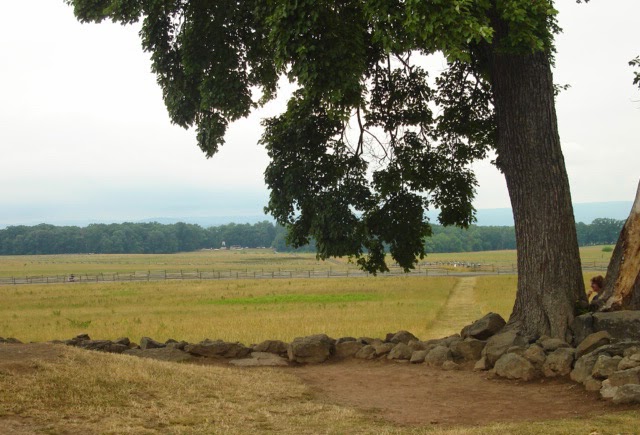
You don’t fully comprehend the magnitude of the Battle of Gettysburg until you visit the site. As you stand atop Little Round Top and look down on Devil’s Den, you appreciate the sacrifice of the men who prevented the Confederates from flanking the Union lines. I remember standing on the Union embankments and looking across the field to the Confederate lines. The Union soldiers fought hard to repulse the Confederate attack and begin the end of the Civil War. 

Tuesday, October 28, 2014

A Nation Remembers

“By the dawn of the twentieth century, Arlington had matured into something more than a Civil War cemetery; it had become a national symbol for sacrifice and honor, a rallying point for veterans, for ordinary visitors, and for solemn ceremony” (119).

The Book

On Hallowed Ground: The Story of Arlington National Cemetery by Robert M. Poole provides the reader with a history of America’s most famous cemetery. Arlington National Cemetery was born out of the Civil War and has been inexplicable linked to each of America’s wars since then. The land originally belonged to Mary Custis Lee, the wife of Robert E. Lee and great-granddaughter of Martha Washington. When Robert E. Lee chose to resign from the Union and lead the Confederate army, Arlington became a part of the Union’s defense of Washington, DC. Throughout much of its early history, the cemetery was a bridge, and was caught, between the struggle between the North and the South.

Arlington began as a 200 acre cemetery in 1864 and has grown to 624 acres. The white tombstones were put into practice in 1874 and the Tomb of the Unknown was dedicated on November 11, 1921. The United States Army Old Guard is tasked with the twenty-four hour guarding of the Tomb of the Unknown. The best part of On Hallowed Ground is Poole’s description of the Old Guard and their reverence for the Unknown Soldiers.

Overall, Poole does a good job explaining the creation of the cemetery and the people involved. However, some aspects of Arlington’s history and traditions are glossed over in deference to other events. For example, Poole spends an entire chapter on President Kennedy’s funeral, while only a couple of pages detailing the Old Guard. This decision plays into the complaints Poole details from the families who lost ordinary soldiers: more important people were often given more prominent burial plots and better funerals than the ordinary soldier.

The Place


Arlington NationalCemetery is located across the Potomac River from the Lincoln Memorial. Tours are available and they stop at the Tomb of the Unknown, President Kennedy gravesite, and Arlington House. Visitors can pick up a map at the Visitor Center to find the gravesites of famous Americans or family members.

The Tomb of the Unknown is humbling and the viewing of the changing of the guard is a unique experience. As you stand in the crowd, all you hear is the clicking of the soldier’s heels and you are struck by the sacrifice of the Unknowns and their families. Across from the Tomb of the Unknown are several memorials for the USS Maine, the Iran Hostage Rescue Team, and the Space Shuttles Challenger and Columbia. At the Arlington House, you have a sweeping view of the Potomac River and Washington, DC. Just in front of Arlington House lies Pierre Charles L’Enfant. L’Enfant was a Frenchmen who served in the Revolutionary War and designed the layout for the new capital city: Washington, DC. For his devotion to his adopted country, L’Enfant’s grave has the best view.

A visit to Arlington is not your typical tourist stop; it is a cemetery and visitors are expected to be reverent and respectful.